Kierkegaard, the Danish Philosopher, argues that Christianity as we know it today barely relates itself to the message that Jesus preached in the New Testament. Christians are not striving to come closer to the Christianity of the New Testament, he further maintains. I am no Christian apologetic, but I find it necessary to analyze the veracity of Kierkegaard’s claim.
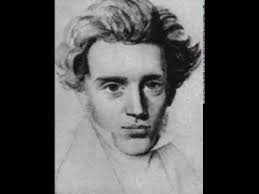 He maintains that Luther had written 95 theses to show Christianity’s wretchedness, but today only one is necessary— honestly. When we juxtapose the way we are living the Christian life with the one preached in the New Testament, they almost have nothing in common. Official Christianity does not even dare to make clear the requirement of Jesus’ teachings in the new testament because that would bring to light how far removed the two are. We, Christians, live and love in the ordinary human way and so fail to live the extraordinary life that Christianity requires of us. Diognetus had written a letter to Christian in the third century. in it, he remarked that although are similar to other men by nationality, language or customs. They do not inhabit separate cities of their own, or speak a strange dialect, they are distinct by the way they lived. This is no longer true unfortunately. and the consequent is dire.
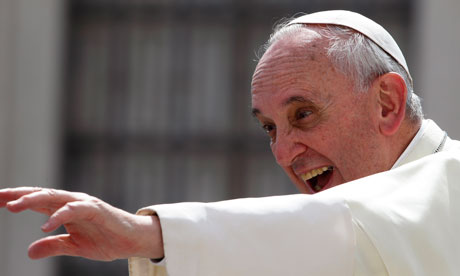
To illustrate his point, he gives an example. A Christian teacher is paid several thousand dollars as his wages. If we suppress the Christian criterion and assume the ordinary ‘human criterion’, which encourages that a person should have his wages for his work in order to live a respectable life with his family and maintain a perfect life’s standard, then that’s great. However, as soon as the idea of Christian poverty is asserted, several thousand is too high a salary. Christianity requires that when our most basic needs are met, the rest be given to the poor. One can live best the Christian requirement only in poverty (of spirit). It is dishonesty to call ourselves Christian when we so miserably fail to live the Christian requirement. We are dishonest about doing what Jesus requires. We give them our own interpretation according to our own expediency; nevertheless, the way we live is so far removed from the Sermon on the Mount’s requirements. “I will not participate… in what is called Christianity”, Kierkegaard says. even Pope Francis shockingly said that, “God would not be Christian if he comes back today”— loosely interpreted, christianity has become too pharisaical. We need to go back to the the beginning seriously. 
Now how right is Kierkegaard? I believe that the Christian life cannot be reduced to a few critiques. They are people who genuinely try to abide by the teaching of Jesus. Christianity However, it would make Christianity and Christians much more respectable in the world if we actually take very seriously Kierkegaard’s critic. Have you seen how lovable and respectable those who take the Christian faith very seriously are? Not only people respect their sacrifice, they are also attracted to their joy and peace. Religious freedom is being challenged everywhere in the world; perhaps if we take Christianity as Kierkegaard advocated it, no one would dare challenge it since our service would be in so much demands. I must admit as a group, we don’t stand out. We are just like everyone else. There is no way to differentiate Christians and the crowd. We go to their theaters, we watch whatever they want us to watch, we learn what they teach us, and we follow their rules even if they violate our conscience. How do you think the early Christians were able to conquer the world and spread the Word so quickly? It was because they accepted to set a standard tailored after the heart of Jesus— a standard that the ordinary world despised. Of course, that caused them to be imprisoned, mistreated, guillotined and killed, but it also put the world on the path to salvation. Due to our radical examples, the world fell to its knees and asked us for help. Our standards gave meaning to life, put life in right order, and helped put life in perspective.
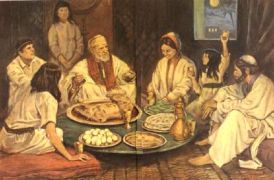 Today, that standard is lost because we’ve gotten too comfortable over the years. the world has re-conquered the low standard in which it was living before Christianity blossomed. They are winning big time and the powerful force that is Christianity is sleeping. Until we wake up, Kierkegaard’s voice will keep on echoing on our cathedrals, churches, chapels, seminaries, schools, and workplaces. Until then, his voice will continue to resound in our deepest conscience that this Christianity is too far removed from the one preached in the Bible.

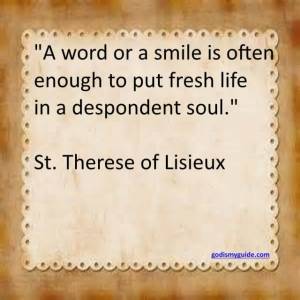 Charity penetrates even the most hardened hearts; it heals even the most wounded; it soothes and frees the soul to focus on its natural inclination. Therese overcomes her temptations by mean of love. Charity changes mind and heart. It opens doors. She focused in growing in personal love, then that affects those around her drastically; love is irresistible; confronting the sister would create more friction and pain. Fraternal correction would only hurt her pride. How many today are wounded, broken, bruised, abused, and used because they don’t know how to love? Instead of detesting that sister, who gave her at first every chance to do so, she prefers to see Jesus hidden n the depths of her soul.
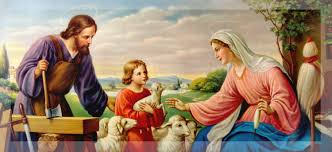 The Mother of God is elevated to the highest pedestal attainable by a human being. She deserves this because her life on earth matches the blueprint in God’s mind; she is, and deservedly so, the highest honor of our race and the mother of our salvation. This honor is due to her fiat and her intrinsic connection to the divine Son of God. She is Theotokos— God’s bearer—and the mother of all mankind. However, something would be amiss if the Son of God was deprived of a father. Thus Joseph occupied a pivotal place in the economy of salvation. He is the second greatest saint in the eyes of the church. He was handpicked to fulfill a primordial role.
 However, this role was not a walk in the park. Like Mary, he was not given a special grace from birth to be the father of God. He was a sinner striving to be virtuous. So it was not easy for him to deal with mystery, so he must have struggled to accept the angel’s annunciation to him. Someone being pregnant through the power of the Holy Spirit is mind blowing and unprecedented. Although a man of faith, he could not have swimmingly accepted this occurrence. To make things worse, out of all the possible mediums, God chose a dream to announce the greatest of news. Sheer madness, however that’s God’s madness. Madness that comes from God is much more beautiful than wisdom of human origin. Despite all the researches done on dream, we still don’t know how best to take dreams. So human that he was, he struggled to decipher what was being asked of him. When things come to light however, he cooperates wholeheartedly. That’s a lesson for all of us. It is reasonable to struggle to figure out God’s plan for our lives, but once evident, leave no room for doubt. Commit as if there had never been any doubt.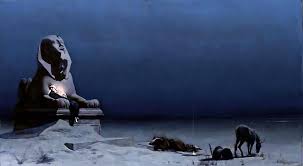
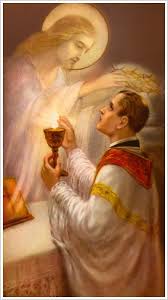 Moreover, Joseph teaches the priest how to deal with mysterious phenomena. Joseph was human dealing with God’s mystery (Jesus) and the greatest human (God’s spouse). The priest is a human being dealing with God (the Eucharist) and fragile souls that he must save. As eli the prophet once remarked when his sons were mishandling the sacrifice of the temple: “If a man sins against another man, God can mediate for the guilty party. But if he sins against the LORD, who can intercede?” (1 sam. 2:25).



 Joebricereview