The path of peace without violence is not an easy one. But when it is done well, it is a jewel to behold.
A striking passage in pope Benedict XVI’s encyclical– Charity in Truth (June 29, 2009)— made the following point: even if justice constitutes the basis of all society, it needs the “ethic of gratuity” in order to function well. Justice is to give another his due; charity compels us to give what’s ours to another. So charity goes beyond justice. Justice is “the minimum measure”. Charity demands justice. That means intrinsic to charity there is some form of justice. Here is the point– society is built according to law and justice, both commutative and distributive, but charity transcends justice and completes it in the logic of giving and forgiving. Society flourishes not merely by relationships of rights and duties, but fundamentally by relationships of gratuitousness, mercy, and communion (Caritas in Veritate, 6).
As we remember Martin Luther King today, it is worth pointing out how well he brought about this ethic of gratuity in the civil right movement in the 1960s. He commenced that movement in order to put a final end to slavery, oppression, discrimination, segregation, and injustice suffered by the black community. He chose the path of non-violence although in all justice, he would have been right to have recourse to revenge. Despite the many deaths, burning of churches, police brutality he and his people endured, he remained firm in the conviction that darkness couldn’t drive out darkness. Hate cannot drive out hate; only love and reconciliation can do that. Unlike his predecessors Malcom X and co., he preferred peace because he knows unarmed truth and unconditional love always have the final word in reality. After the movement, he could have asked for restitution and justice from the US for all the many years of violence and injustice the blacks have suffered, but he chose to move on. he was moved by Charity.
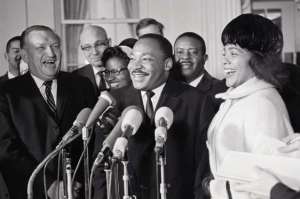 Charity ennobles the act of the human person. Because he was acting in charity, even those who had no particular interest in the movement joined him. Charity moves the heart of others. So, because of his choice and vision and the principle of gratuity from which he acted, his dream of seeing black and white forming one community was realized. Had he chosen to do otherwise would his dream ever become true? Where would America be today? Would America ever rule the world? While we will never know, what we do know is that he will remain a model to follow for generations.
After WWII, Germany was in dire need of the principle of gratuity. The world chose and rightly so not to punish the German nation despite the many atrocities they had caused and so allowed them to build itself up and embrace its dignity again. The world works so hard to unite West and East Germany after the war, and in 1989, it became a reality. Had the world applied strict justice on the Germans, where would they be today? Because of this gratuity, there are no grudges between Germany and world today. I would say it is this principle that drives the ‘welfare system’ in America. So, clearly many don’t deserve food, housing, social security benefit, free Medicare etc., but is it justice to let them wallow in their misery? If it is, is it charitable to do so? So while justice must always be preferred to injustice, we need to leaven of charity to give savor to the common good. otherwise, the society cannot function well.

 Hiding behind the Holy face of Christ was a mean to console those through whom Christ is suffering. First, through the Holy Face, she associates the suffering of her father, who was mentally ill, by extension all sufferings, to the passion of Christ. She thus received permission to add to her religious name ‘of the Holy face’. Thus, her complete name became “St. Therese of Lisieux of the Child Jesus and of the Holy Face”. It was the mirror through which she conceived Christ.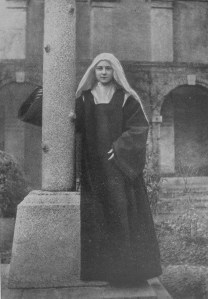
 Therese seems to intuit that method from God. After the Fall, God called Abraham, an unknown and powerless man to leave his country and move to an unknown land (Gen. 12), and made a great nation out of him. Out of all the powerful nations of the world, God chose a small and insignificant country for the savior of the world to be born; what’s more, while under the occupation of the most powerful nation on earth—Rome. In the midst of a wide world full of kingdoms with their mighty events and dramas, he devoted himself to little things, to individual men and women, and on “little people”. In a country where there were popular movements to overthrow the Romans, our Lord devoted many hours to one Samaritan woman, the one Nicodemus, the one Martha, the one Mary Magdalene, the one Lazarus, the one Simon Peter. That tells us the infinite value of the one (the little) is the key to the Christian understanding of the many (the great). God’s greatness is magnified more evidentially in small things.
 What is the “Little Way” of St. Therese anyway? It is to become like a little child and acknowledge our powerlessness before the mighty God. As she puts it at the very beginning of her autobiography, “God’s Love is made manifest as well in a simple soul that does not resist His grace as in one more highly endowed”. Self-abasement is the characteristic of love; it seems that God enjoys coming to little souls. If all souls resembled the holy Doctors who have illuminated the Church, it seems that God would not stoop low enough. But He has created the little child, who knows nothing and can but utter feeble cries, and the poor savage who has only the natural law to guide him, and it is to their hearts that He deigns to stoop”.
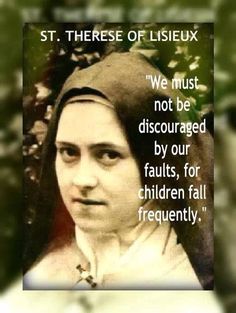 With this, there is nothing counterintuitive about spiritual childish. As Stertenbrink asserts, “who is it within us who believes, hopes, prays, forgives, loves, and trusts? Who is it within us who weeps and laughs?”

 Charity penetrates even the most hardened hearts; it heals even the most wounded; it soothes and frees the soul to focus on its natural inclination. Therese overcomes her temptations by mean of love. Charity changes mind and heart. It opens doors. She focused in growing in personal love, then that affects those around her drastically; love is irresistible; confronting the sister would create more friction and pain. Fraternal correction would only hurt her pride. How many today are wounded, broken, bruised, abused, and used because they don’t know how to love? Instead of detesting that sister, who gave her at first every chance to do so, she prefers to see Jesus hidden n the depths of her soul.
 This insight into the mystery of God encapsulates the call of every Christian. Love alone allows us to become godlike. From a Christian point of view, it is a noble task to be the mother Teresa of the poorest of the poor; it is praiseworthy to fight for justice like martin Luther king using nonviolence; it is ideal to convert a continent like the religious missionaries of the 16th to 18th centuries. However, unless charity constitutes the cornerstone of this endeavor, it does not leave an indelible mark in The Book of Life. All human inspiration must begin with charity and lead ultimately to greater charity. When she was seeking for her specific call (since she was already a Carmelite sister engaged to pray for priests) within the church, St. Therese of Lisieux discovered a pivotal and illuminating passage in the epistle of St. Paul that points her toward the epicenter of what it means to follow Christ.
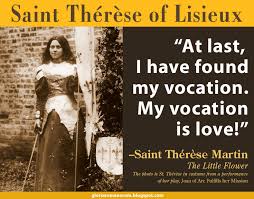 Charity is the breadth, length, height, and depth of all vocations. The heart of the church burns with love, as she understands her. Love is the heart that pumps blood in the body of the church enabling her to function. It is love that makes the heart of the church beats. “If love ever becomes extinct, apostles would not preach the gospel, martyrs would refuse to shed their blood, and priests would become social workers. Love is everything because it encapsulates all vocation. In the midst of this discovery, she uproariously exclaimed “MY VOCATION IS LOVE; in the heart of the church, my mother, I shall be Love”.
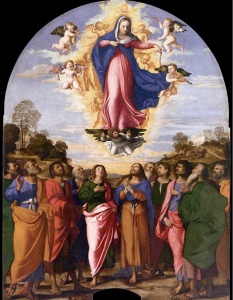 Reflecting on what God had accomplished through her, it is concluded that she is the highest honor of our race. Why? No human beings can deem to be the bearer (mother) of God. No one occupies such a pivotal role in the liberation of a race as she did. No hero or heroine was that crucial in any cause. Our salvation begun as a result her fiat; we could speculate about what would have happened had she responded negatively, but all we know she did not. Because of her, heaven and earth, God and human had come together. By such occurrence, the human race that was galloping in the direction of hell makes a U-turn. The church never fails to honor her for playing such a powerful role. That’s why we dare call her Mediatrix, Co-Redemptoris of our salvation. That means she was the spark that started the whole fire though she probably did not foresee the consequences of her fiat. God could have done otherwise of course had he preferred it, but he did not and she cooperated with the divine plan. We can all learn from her exemplary life. Don’t we all want to do something heroic, magnificent, and extraordinary? Well, we can. Search for God’s plan and follow it intensely. Then be ready to be amazed.
 Moreover, as the greatest mother who had ever lived, she is a great model of what it means to be an excellent mother, and a teacher to all fathers. To all women, she teaches how to accompany a child as the child is trying to grow in wisdom and age. She let him be, and through that she discovered who he is—do whatever he tells you (John 2). To fathers, she teaches how to treat a child when things don’t go as planned. Finding him in the temple, notice how she did not yell at him, but rather she asked him a question— Son, why have you treated us this way (Luke 2:48)? Joseph stands there and observes how she does it. we men don’t handle things this way. Another lesson is that in our attempt to help those who need help in this journey, she is a great example of how best to do so— never in a nagging or imposing way. She teaches us that asking questions, attentive listening go a long way.
 The church is in the business of reintegration not casting off. She is always ready to pour out the balm of God’s mercy on all those who ask for it with a sincere heart (Amoris Laetitia 296). So, if someone exhibits a way of life incompatible with the Christian ideal, that person needs to let the gospel penetrates his life so he can experience conversion. Pastors of souls are there to help through that process. that simply means there will be a lot of new beginnings and fall start. The church’s role is simple to patiently stand alongside each person as they keep on trying. Again, this is the first time a church document dealing with doctrine is juxtaposing doctrine and spiritual growth.
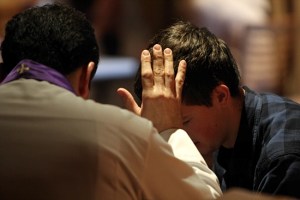 Without falling into casuistry, the document cleverly maintains that not all divorced and civilly remarried can be pigeonholed as one. There must be “a renewed encouragement to undertake a responsible personal and pastoral discernment of particular cases since the degree of responsibility is not equal in all cases”. Therefore, priests have a duty to initiate a process of accompaniment and discernment in order to “guide the divorced and remarried to an awareness of their situation before God (300). A pastor cannot feel that it is enough simply to apply moral laws to those living in “irregular” situations, as if they were stones to throw at people’s lives (305).
 t preserve the essential form and structure of what came before it. It is genuine if it retains one and the same type, the same principles, the same organization; if its beginnings anticipate its subsequent phases, and its later phenomena protect and subserve its earlier; if it has a power of assimilation and revival, and a vigorous action from first to last. By the same token, butterfly can be seen as a genuinely development of caterpillar. While butterfly is not the same as a caterpillar, it preserves the essential form and structure of a caterpillar.
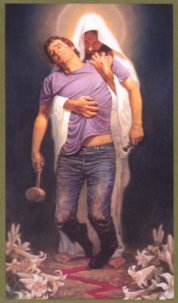 We know this is true instinctively; on one hand, we can enter into the depth of ourselves through silence and prayer, becoming as much like the angels as possible. On the other, we experience instincts and emotions that often get the better of us. as long as we are journey in this life, we struggle to strike a perfect balance between these two realities.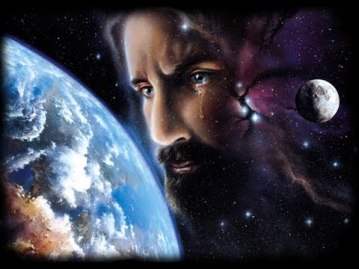


 Joebricereview